The Torque Trap: Why Amputees 'Corkscrew' Through Life
The pain isn't coming from your prosthesis; it's coming from a failure in your Lumbo-Pelvic-Hip Complex—your body's internal Command Center.
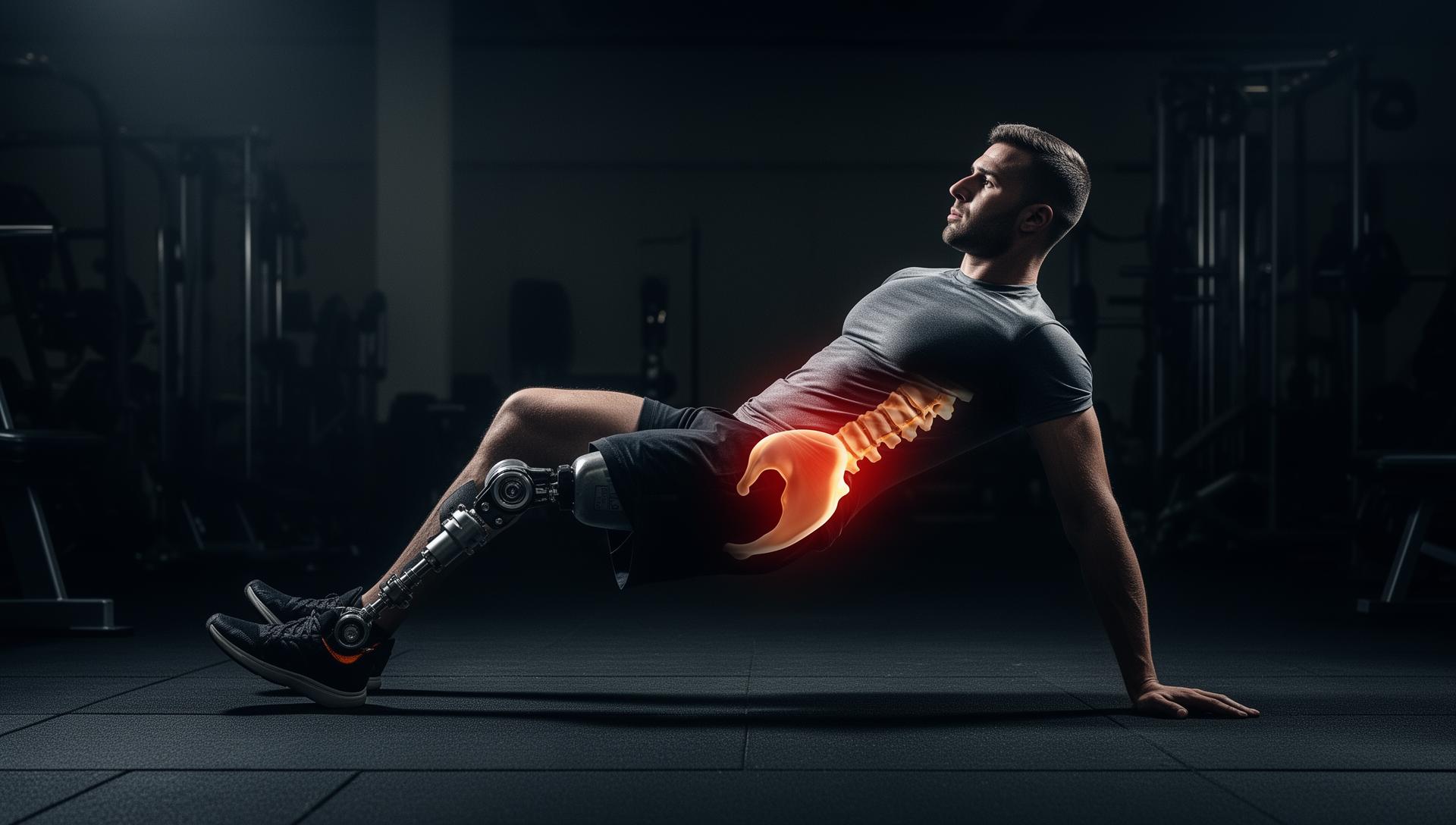
If you are a Below-Knee (BK) amputee, you likely live with a persistent, nagging ache in your lower back or your "sound side" hip. Most of us are told it's just part of the tax we pay for walking on carbon fiber.
It isn't.
The pain isn't coming from your prosthesis; it's coming from a failure in your Lumbo-Pelvic-Hip Complex (LPHC)—your body's internal Command Center. When this system isn't anchored, your spine becomes a wet towel being wrung out with every step.
The Biomechanics of the "Corkscrew"
In a two-legged body, the ankle and calf provide a "tripod" of stability. When you lose that distal stabilizer, your hip must take over 100% of the workload. If your LPHC is weak or "disengaged," your body defaults to a survival strategy called Transverse Plane Compensation.
Because you can't "push off" with a biological foot, your brain "whips" the prosthetic leg forward by rotating the pelvis. This creates a Torque Trap: your upper body stays forward while your hips twist aggressively to clear the floor. This "corkscrewing" shears the spinal discs and the SI joint, leading to the chronic inflammation that defines "Amputee Back."
Proprioceptive Ghosting
The reason you can't just "walk better" is a phenomenon known as Proprioceptive Ghosting. Your brain is a high-speed computer that relies on feedback to map your movement. Because it isn't receiving a clear signal from a biological ankle, the neural pathway to the glute on the residual side begins to "dim."
You are essentially trying to drive a high-performance car where the rear-left wheel isn't connected to the steering column. No amount of "trying harder" fixes a disconnected circuit. To stop the pain, we have to re-establish that connection.
Moving from 'Stiff Strut' to 'Stable Anchor'
To break the Torque Trap, we have to move away from the "Stiff Strut" strategy—where we brace the whole leg and hike the hip—and move toward Anti-Rotation. True stability for a BK athlete isn't about doing 100 crunches. It's about training the LPHC to resist the twist. We have to re-map the brain's connection to the residual glute through high-tension isometrics and the Softening techniques that clear the neurological noise in the socket.
The Path to Agency
Mastering the LPHC is the difference between being a passenger in your prosthesis and being the operator of your movement. When the Command Center is dialed in, the back pain subsides because the spine is no longer being wrenched. You aren't just stronger; you are more aerodynamic.
This is why I built the Amputee Strength & Performance Program. Because every amputation and every socket interface is unique, a generic "glute bridge" isn't enough to re-map your nervous system. This program focuses on the specific "Anti-Rotation" drills and "Softening" protocols required to stabilize your unique system, eliminate chronic pain, and reclaim your movement.
If you're ready to stop fighting your prosthesis and start commanding it, Learn More about Amputee Coaching →.

About the Author
Sam Maddaus
U.S. Navy veteran, below-knee amputee, Certified Strength Coach, and Wilderness First Responder. Sam has thru-hiked the 2,650-mile Pacific Crest Trail, solo bikepacked 16,000 miles from Alaska to Argentina, and provided prosthetic care in Guatemala. He coaches from lived experience—building programs rooted in structural integrity, intentional movement, and mission-ready preparation.